

Which Comes First, an Audience or an Income?
Create Assets, Build an Audience and Grow Your Income into a Mini-Media Empire

“But, I don’t have an audience like you do . . .,” is the excuse I hear every day.
This is a lie you keep buying into. That you “need” something first before you can create the thing, write the book or record the song.
I didn’t have a single sub when I launched my Substack ten months ago. The first two months I didn’t make enough to pay the electric bill, but I treated it like a job anyway.
Slowly things started to move. I think it was article 12 and video 15 on YouTube that resulted in that spike of growth you see in October.
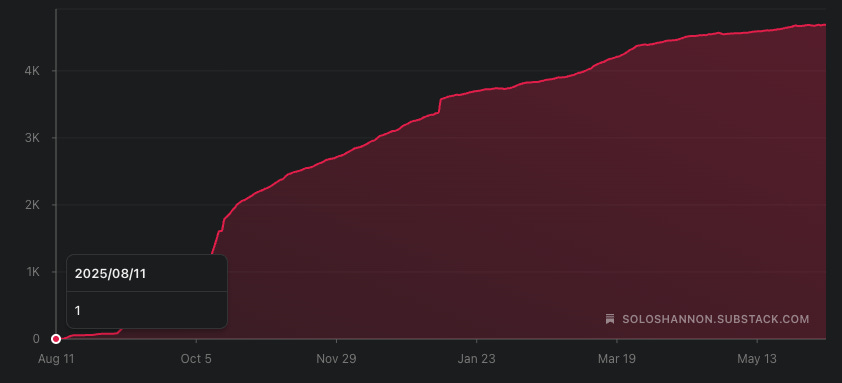
Does any of that equal income?
Fuck no. There is very little correlation between audience size and income.
I coach YouTubers who are 10x my size because they aren’t making any money and I am. And the reason is because I have things to sell and they just have an audience.
Audience does not equal income, it’s just a vanity metric that doesn’t pay the rent.
Audience growth is a side effect of showing up, creating assets and being a real human in a sea of AI output. Your readers/viewers/listeners WILL find you.
What about the people who write and write and never get anywhere?
They’re lying. To themselves and you. I see their Notes too, but when you go look at their Substack they have 4 articles about completely unrelated topics and very little to offer a reader.
The internet is not stacked against us, you and I both know it’s never been easier to go your own way than it is today.
All the tools the big publishers have are available to us now. We can literally stream documentaries directly into people’s living rooms, self-publish books that get sold in little bookstores around the world and drop ship our art prints to Bora Bora.
Our starving artist ancestors are rolling over in their graves.
We’ve got tools at our fingertips they couldn’t even imagine. Direct sales & publishing like this has never been possible before and yet the excuse makers are still wringing their hands in the corner complaining about not being able to make it without an audience.
Audience Not Required
You’ve probably heard about J.K. Rowling (Harry Potter) and Stephanie Meyer (Twilight), neither had an audience before publishing. They both went the traditional route, seeking a publisher to give their work legs. Their audience came from the long-form storytelling asset.
Then there’s Delia Owens, a retired zoologist in her late 60s who had never written anything. I not sure she even had a Facebook page when she published Where the Crawdads Sing. And the publisher did not care because the long-form storytelling was that good.
I saved the best example for last.
Hugh Howey was a 36-year old bookstore clerk when he wrote the short story, Wool. He published it on Amazon through KDP (Kindle Direct Publishing) as a Kindle eBook only. He had no established audience or publisher backing. Just a story he turned into an asset.
Wool began getting dozens of downloads per day, and it inspired him to keep writing. Wool became a multi-book series that got picked up by a traditional publisher for physical book distribution while Howey retained eBook rights. Fast forward ten years and Howey has dozens of books, a TV series (Silo) on AppleTV and more streams of income than he can count.
Howey’s media empire started from one short story and Hollywood has been using this trick for over a hundred years.
What if I told you that there’s a top secret formula every Hollywood studio uses to maximize profit?
Except it’s not top secret, they do it out in the open and it’s more of a step-by-step than a formula but, I digress.
The Marvel Method for Midlife Creatives
Derivatives drive the media industry and the fuel in every tank is a story. Every movie, series, soundtrack, song and merch product begins with writing. Long-form storytelling gets refined, like crude oil, into dozens of income streams.
Marvel shows us step-by-step how to make money from long-form storytelling.
Step 1. Write a story.
Step 2. Write another story.
Step 3. Combine the stories into a book series.
Step 4. Combine the stories into a video/film series.
Step 5. Spin off the soundtrack into a product. Create audiobooks from the book series. Start a podcast based on the story, writing the story or a character from the story.
Step 6. Sell merchandise, artwork, posters, t-shirts from the story.
Step 7. Sell premium experiences based on the story. Heck, they’ve even got rides in themes parks for heaven’s sake.
Marvel takes a single idea (Text/Comic) and immediately designs an ecosystem around it: Audio (soundtracks, podcasts, audiobooks), Video (movies, TV series, documentary behind the scenes), Art (merchandise), and Premium Experiences (birthday party kits, Halloween costumes, cruises, theme parks). They treat creativity as an interconnected web of assets.
“But, Shannon, I’m just a solo creator. . . how in the world is it possible for one person to do this much?”
I’m so glad you asked! I’ve recorded a behind the scenes answer + a tour of my Second Act Studio. Grab your coffee, tea or a bowl of chowder and let’s dig in.
